
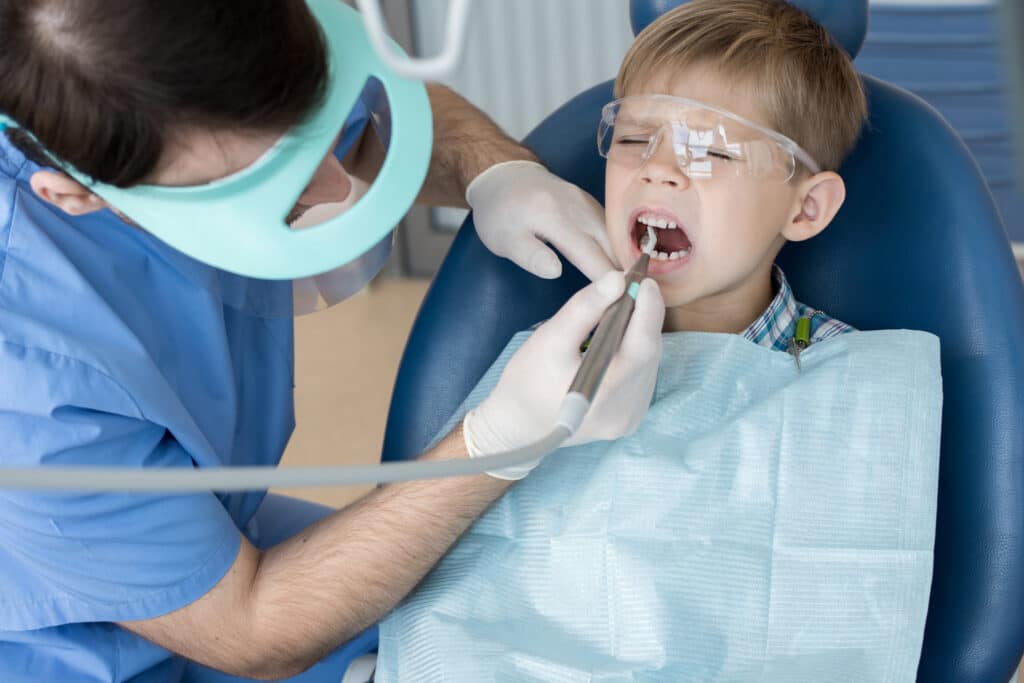
Pediatric dental milestones are specific developmental markers tracked by your dentist to ensure proper oral health from infancy through adolescence. A child’s first dental visit at Chatham Family and Implant Dentistry should occur when their first tooth erupts, or no later than their first birthday, to establish a preventive baseline and prevent early childhood decay.
Why Primary (Baby) Teeth Matter More Than You Think
Clinical literature suggests that primary teeth are valuable assets of a child due to their vital role in eating, phonetics, esthetics, and also as a space maintainer for permanent teeth. [1] (Vittoba et al. 2016). From a developmental standpoint, primary teeth are critical. Baby teeth act as natural space maintainers. They hold the precise blueprint of your child’s jaw for the permanent adult teeth growing beneath the gums. If a baby tooth is lost prematurely to severe decay, the surrounding teeth will quickly shift into that empty space. This traps the adult tooth beneath it, leading to severe crowding, painful impaction, and the potential need for complex orthodontics later in life. Furthermore, healthy baby teeth are essential for your child to develop proper speech and to comfortably chew whole foods.
Table that compares phased care by age
Milestone phase | Primary focus | Commonly performed treatments (as needed) | Maintenance frequency |
Infant | Acclimatization and baseline check | Lap exam | Bi-annual |
Toddler | Early cavity prevention | Gentle polishing | Bi-annual |
Child | Protecting new teeth | Dental sealants | Bi-annual |
Teen | Enamel preservation | Routine cleanings | Bi-annual |
Navigating the At-Home Brushing Routine by Age
A professional pediatric visit every six months is recommended in addition to appropriate oral hygiene techniques at home. As your child hits new milestones, your at-home strategy needs to evolve with them.
- Infants: Even before the first tooth erupts, you should gently wipe your baby’s gums with a clean, damp washcloth after feedings. Once that first tooth appears, upgrade to a soft, silicone finger brush.
- Toddlers: Let them brush first to build their independence, but you must always follow up to do the actual cleaning. Use a tiny smear (the size of a grain of rice) of fluoride toothpaste.
- School-Aged: A great pediatric dental rule of thumb: If your child does not have the manual dexterity to tie their own shoelaces securely, they do not have the dexterity to brush their teeth alone. Continue to supervise their brushing habits and introduce fun, kid-friendly water flossers to clean between tight new adult teeth.
Diet and Your Child’s Enamel
Clinical literature supports the view that nutrition and diet may affect the development and integrity of the oral cavity, as well as the progression of oral diseases [2] (Naidoo et al., 2007). When talking about cavities, most parents immediately think of chocolate and hard candies. However, one big culprit of early childhood tooth decay among our Chatham County patients is actually marketed as a “healthy” snack. Gummy vitamins, sticky fruit snacks, and organic juice boxes are incredibly dense in sugar. Worse, they adhere to the deep grooves of your child’s molars. In dentistry, the frequency of sugar exposure can be more dangerous than the amount. If your toddler sips on a cup of juice over a three-hour period, their enamel is being exposed to the juice’s acid and high sugar content. To protect their milestones, limit juice to meal times only. Between meals, encourage them to drink local Pittsboro tap water, which naturally contains fluoride to remineralize their growing teeth.
Handling Childhood Dental Emergencies Efficiently
As your child learns to walk, run, and play local youth sports, bumps and falls are inevitable. Knowing exactly how to handle a pediatric dental emergency can save their tooth. . If your toddler knocks out a baby front tooth, do not panic, and do not try to push the baby tooth back into the socket. Pushing the tooth back can damage the permanent adult tooth developing underneath. Simply apply a cold compress to their lip, comfort them, and call our clinic. However, if a teenager knocks out a permanent adult tooth, time is of the essence. Gently rinse the tooth with water, place it in a small cup of milk, and drive directly to Chatham Family & Implant Dentistry.
Catching Bite Issues Before Middle School
By your child’s 7th birthday, they reach a developmental milestone called the mixed dentition phase. At this age, they have enough permanent adult teeth for our doctors to evaluate the overall size and shape of their jaw. During this milestone visit, we perform an early orthodontic screening. We are looking for issues like crossbites, severe crowding, and signs of chronic mouth-breathing. Clinical literature indicates that Malocclusion is often caused by local disorders during tooth replacement in children [3] (Zhou et al., 2024). If we spot a developing problem, we can often use simple Phase 1 early interventions to guide their jaw growth while their bones are still soft and malleable. Catching these bite issues before they reach middle school often means they will spend significantly less time in braces as a teenager, saving your family both time and money in the future.
FAQS
1. Will my 1-year-old actually sit still for a dental exam?
Usually, no, and we do not expect them to! For infants and toddlers, we use a “knee-to-knee lap exam.” Your child will sit comfortably on your lap facing you, and gently lean back onto the dentist’s lap.
2. Is thumb-sucking going to permanently ruin my toddler’s teeth?
Not immediately. Thumb-sucking and pacifier use are completely normal self-soothing behaviors for infants. However, if the habit continues aggressively past age 3 or 4, it can begin to narrow the dental arch and push the front teeth outward.
3. When do we transition from a pediatric hygiene routine to an adult cleaning?
Typically, children transition to a more traditional, adult-style cleaning around the time they get their braces off or their full set of permanent adult teeth erupts.
About The Author
Dr. Colin Barbaro, DDS, provides comprehensive general and cosmetic dentistry at Azalea Dental in Wilmington, NC. With advanced surgical training from a VA hospital residency, he specializes in implant placement, TMJ therapy, restorative care, and endodontics. He is committed to delivering safe, evidence-based solutions that keep patients comfortable and informed at every step.
References
[1] Vittoba Setty, J., & Srinivasan, I. (2016). Knowledge and Awareness of Primary Teeth and Their Importance among Parents in Bengaluru City, India. International journal of clinical pediatric dentistry, 9(1), 56–61. https://doi.org/10.5005/jp-journals-10005-1334
[2] Naidoo, S., & Myburgh, N. (2007). Nutrition, oral health and the young child. Maternal & child nutrition, 3(4), 312–321. https://doi.org/10.1111/j.1740-8709.2007.00115.x
[3] Zhou, C., Duan, P., He, H., Song, J., Hu, M., Liu, Y., Liu, Y., Guo, J., Jin, F., Cao, Y., Jiang, L., Ye, Q., Zhu, M., Jiang, B., Ruan, W., Yuan, X., Li, H., Zou, R., Tian, Y., Gao, L., … Li, X. (2024). Expert consensus on pediatric orthodontic therapies of malocclusions in children. International journal of oral science, 16(1), 32. https://doi.org/10.1038/s41368-024-00299-8