
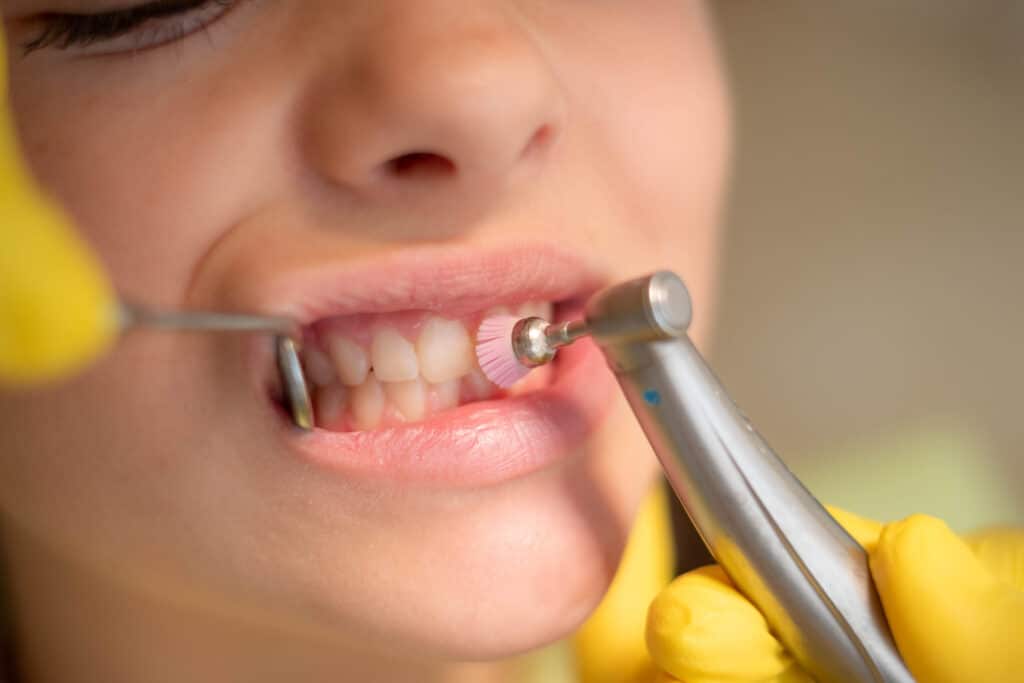
A pain-free dental cleaning is a specialized preventive treatment that uses advanced ultrasonic technology, topical numbing agents, and customized pacing to remove plaque and tartar without discomfort. At Chatham Family & Implant Dentistry, this gentle approach ensures patients with dental anxiety can maintain their oral health without experiencing pain.
Why Cold Water Can Hurt Sensitive Teeth
If you have sensitive teeth, you already know the sharp, sudden jolt of freezing water hitting your gums. For many patients, the cold water used during a standard cleaning is actually the most painful part of the entire visit. This happens because receding gums or thinning enamel expose the microscopic nerve endings inside your teeth to sudden temperature drops. You do not have to dread the rinse. At Chatham Family & Implant Dentistry, we eliminate this temperature shock entirely. Our treatment rooms are equipped with temperature-regulated water systems. By using lukewarm water through our ultrasonic tools and rinses, we prevent the temperature shock that triggers sensitivity pain.
The "Tell-Show-Do" Philosophy
Medical literature suggests that the Tell-Show-Do approach was more effective than the ask-tell-ask approach in alleviating dental anxiety [1] (Elicherla et al., 2024). A large part of dental anxiety comes from the fear of the unknown. Lying back in a chair while someone works inside your mouth can make you feel less in control. We understand that feeling, and we actively work to reverse it. We use a trusted communication technique called “Tell-Show-Do.” First, we tell you exactly what we are about to do. Next, we show you the tool and explain how it works. Finally, we proceed with the step only after you give us the green light. More importantly, we always remind our patients that they are always the boss of their appointments. If you ever feel overwhelmed or need a break, we will stop immediately and restart when you feel most comfortable.
Table comparing scraping and ultrasonic cleanings
Feature | Traditional manual cleaning | Ultrasonic cleaning |
Primary tool used | Stainless steel scalers | Water vibration tools |
Sensation | Pulling and pressure | Vibration and cooling water |
Time in chair | Longer | 20 to 30% faster |
Gum irritation risk | Moderate | Very low |
Anxiety level | High for sensitive patients | Low |
Topical Gels vs. Injections
Clinical literature supports the use of topical anesthetics to reduce discomfort, pain, and anxiety during dental procedures [2] (Lee, 2016). While local anesthesia is necessary for heavy restorative work, you absolutely do not need a shot just to get a comfortable teeth cleaning. If you have highly sensitive gums, we rely on powerful topical anesthetics. These come in the form of a pleasant-tasting gel or a specialized mouth rinse. We gently swab the gel directly onto your gums a few minutes before your cleaning begins. It quickly numbs the surface tissue, turning potential sharp pinches into nothing more than dull pressure. The numbness wears off shortly after you leave the office, meaning you can go right back to your day without a drooping smile.
How We Treat Receding Gums Without the Sharp Pain
Clinical data show that ultrasonic and manual instruments are equally effective in the treatment of nonsurgical periodontal disease [3] (Sabatini et al., 2024). Gum recession is incredibly common, especially as we age or if we have a history of brushing too hard. When your gums pull back, they expose the root of the tooth. Unlike the crown of your tooth, the root does not have a hard protective layer of enamel. Scraping this exposed root with a metal tool causes intense, shooting pain. We take a completely different approach for patients with receding gums. Our hygienists map out your exact areas of recession before the cleaning starts. We completely avoid aggressive manual scaling in these delicate zones. Instead, we rely heavily on our gentle ultrasonic water scalers, adjust the vibration frequency to the lowest effective setting, and apply a premium desensitizing paste directly to the exposed roots to block nerve pain on contact.
A Calming Environment Designed for Chatham County Locals
Your comfort requires more than just gentle dental tools; it requires a relaxing environment from the moment you walk through our doors. We know that busy professionals commuting and parents juggling school drop-offs do not have time to stress over a chaotic, clinical dental visit. We have designed our practice to feel more like a local wellness space than a traditional clinic. From the welcoming smiles of our front desk team to the calming amenities offered in our treatment rooms, every detail is intentional. We provide noise-canceling headphones so you can listen to your favorite podcast or music, blocking out the standard noises of a dental office. You can simply close your eyes, unwind, and let our expert team protect your smile in total peace.
FAQS
1. Is teeth cleaning painful at a dental clinic?
It absolutely should not be. While you might feel light pressure or vibration, a modern teeth cleaning is not supposed to hurt. If you have active gum disease (gingivitis) or exposed tooth roots, traditional cleanings can be uncomfortable. However, by communicating with your hygienist, we can use topical gels and ultrasonic tools to eliminate that pain entirely.
2. Can I get my mouth numbed for a routine teeth cleaning?
Yes! If you suffer from extreme sensitivity or dental anxiety, we can apply a professional-grade topical anesthetic gel to your gums before we begin. For patients requiring a “deep cleaning” (scaling and root planing), we utilize local anesthesia to ensure you do not feel a thing.
3. Why do my teeth ache for days after a dental cleaning?
Post-cleaning aches usually occur when heavy, hardened tartar is removed from the gum line, exposing roots that haven’t felt hot or cold air in months. It can also be caused by aggressive manual scraping. Our gentle ultrasonic approach minimizes this tissue trauma, significantly reducing or completely eliminating post-appointment soreness.
About The Author
Dr. Colin Barbaro, DDS, provides comprehensive general and cosmetic dentistry at Azalea Dental in Wilmington, NC. With advanced surgical training from a VA hospital residency, he specializes in implant placement, TMJ therapy, restorative care, and endodontics. He is committed to delivering safe, evidence-based solutions that keep patients comfortable and informed at every step.
References
[1] Elicherla, N. R., Saikiran, K. V., Anchala, K., Elicherla, S. R., & Nuvvula, S. (2024). Evaluation of the effectiveness of tell-show-do and ask-tell-ask in the management of dental fear and anxiety: a double-blinded randomized control trial. Journal of dental anesthesia and pain medicine, 24(1), 57–65. https://doi.org/10.17245/jdapm.2024.24.1.57
[2] Lee H. S. (2016). Recent advances in topical anesthesia. Journal of dental anesthesia and pain medicine, 16(4), 237–244. https://doi.org/10.17245/jdapm.2016.16.4.237
[3] Sabatini, S., Maiorani, C., Bassignani, J., Cotellessa, S., Di Trani, G., Fulgenzi, E., Iacono, R., Mercogliano, I., & Butera, A. (2024). Effectiveness of Ultrasonic and Manual Instrumentation in Nonsurgical Periodontal Therapy: Are Additional Therapies More Effective? A Systematic Review. Applied Sciences, 14(5), 1950. https://doi.org/10.3390/app14051950