
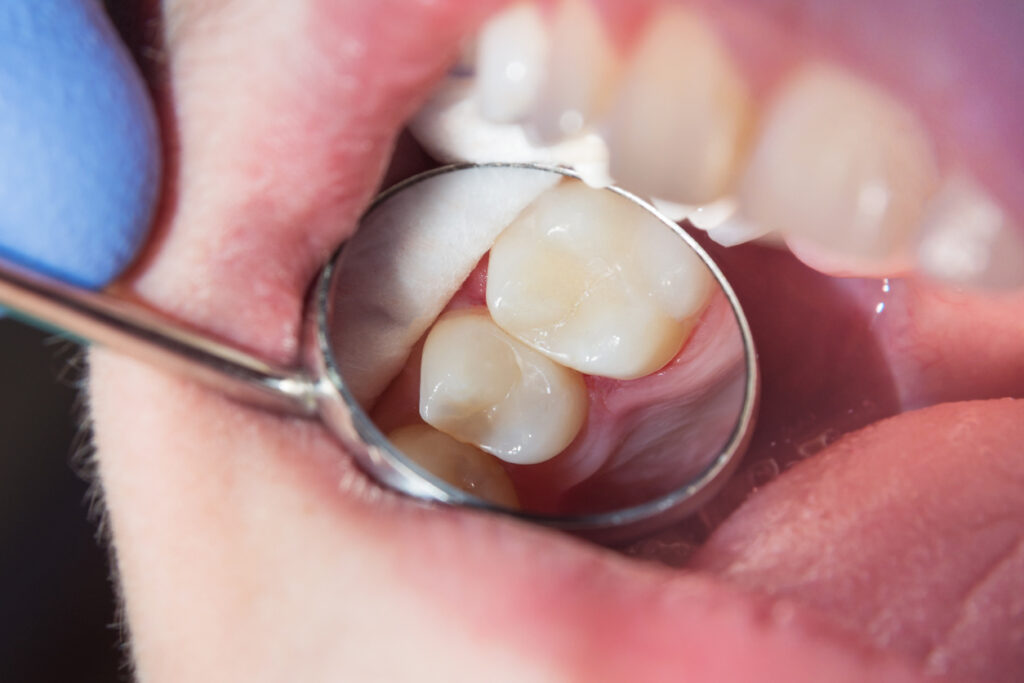
When we find a cavity during your dental exam, our clinical team at Chatham Family & Implant Dentistry immediately assesses the decay using high-definition 3D imaging. We categorize the issue as either a reversible micro-cavity placed on our preventive “Watch List,” a minor issue for a same-day composite filling, or deep decay requiring strategic treatment phasing.
Why We Replaced Silver Fillings with Advanced Composite Resin
Medical literature suggests that current amalgam use has not posed a health risk beyond allergic reactions in a few patients [1] (Rathore et al., 2012). For decades, the dental industry relied on dark, metallic amalgam (silver) fillings to repair cavities. While durable, these outdated restorations have a major hidden flaw: metal expands and contracts when exposed to hot coffee or ice water. Over the years, this constant temperature shifting creates microscopic fractures in your enamel, eventually causing the tooth to crack. At our Pittsboro clinic, we have completely retired the use of silver fillings. Instead, we exclusively use advanced composite resin. This biocompatible material does not just sit inside the cavity; it chemically bonds to the microscopic grooves of your tooth. This modern adhesive actually restores the structural integrity of your enamel from the inside out. \Because we custom-shade the resin to match your exact tooth color, your final repair is completely invisible.
The Hidden Threat: Treating Cavities Between Your Teeth
These are called “interproximal cavities,” and they form in the tight, dark spaces between your teeth where your toothbrush simply cannot reach. Clinical evidence supports that not all interproximal surfaces are equally susceptible, and in particular, distal surfaces of both maxillary and mandibular second premolars were at least three times more likely to decay than other premolar interproximal surfaces [2] (Demirci et al., 2010). Because these cavities hide beneath the visible surface, they are virtually impossible to spot with the naked eye. We rely on low-radiation digital sensors to detect this hidden decay in its absolute earliest stages. When we repair an interproximal cavity, we use a highly precise, minimally invasive approach. Our doctors gently access the side of the tooth, remove the trapped bacteria, and seal the area with composite bonding without altering the healthy chewing surface on top.
Table that compares restorative options
Treatment category | Best for | Out-of-pocket cost | Durability | Maintenance level |
The watch list | Micro cavities | Very low | Varies | High |
Composite fillings | Active mild to moderate enamel decay | Low to moderate | 5-10 years | Low |
Porcelain crown | Severe decay | Moderate | 10-15 years | Low |
Root canal therapy | Deep decay that has infected the tooth nerve | High | 10-15 years | Moderate |
Replacing Old Restorations: When a Previous Filling Fails
Many of our adult patients are surprised to learn that a tooth they had filled 15 years ago has a brand-new cavity. Dental restorations are incredibly strong, but they do not last forever. Over time, the daily pressure of chewing and stress-induced jaw clenching can cause old fillings to wear down or pull away from the edges of the teeth. Clinical evidence suggests that filling removal requested by the patient should be considered critically, as most of these fillings are caries-free [3] (Kirsch et al., 2016). When a microscopic gap forms, aggressive bacteria slip underneath the old filling and begin eating away at the unprotected dentin. This is known as secondary decay. During your exam, our high-definition intraoral cameras easily spot leaking or failing restorations. We seamlessly remove the old, compromised filling, thoroughly clean out the new bacterial infection, and upgrade your tooth with a brand-new, tightly sealed composite restoration before the decay reaches the nerve.
When Toddlers Get Cavities: Repairing Primary Enamel
A common misconception among parents is that cavities in primary (baby) teeth do not need to be filled because the tooth will eventually fall out anyway. In reality, ignoring decay in a toddler’s mouth is highly dangerous. Baby teeth serve as the essential structural blueprint for the adult teeth that grow beneath them. If a cavity rots a primary tooth prematurely, the surrounding teeth will shift aggressively, trapping the permanent teeth and leading to expensive orthodontic issues later. We know that treating a cavity in a young child requires a vastly different approach. We utilize a highly sensory-safe environment for our pediatric repairs. By using the “Tell-Show-Do” method, quiet instruments, and rapid curing lights, we fix the baby tooth before your child even realizes the work has begun. We save the primary tooth, protect their adult smile, and ensure they leave the clinic feeling proud and brave.
What to Expect After Your Filling: Managing Temporary Sensitivity
Because a cavity filling is a non-surgical procedure, there is absolutely no downtime. Once you leave our office, you can safely head right back to work in the Triangle or jump into the Chatham County school pickup line. However, because we work incredibly close to the sensitive nerve center of your tooth, it is completely normal to experience a phenomenon known as “pulpitis” for a few days following your visit. Your newly repaired tooth might feel a brief, sharp twinge when you drink ice water or bite into something crunchy. This is simply your dental nerve healing and settling down after the procedure. To ensure a smooth recovery, we recommend chewing on the opposite side of your mouth until the local anesthetic completely wears off and using a desensitizing toothpaste at home for the first 48 hours.
FAQS
1. Do you use silver fillings, or will my repair be noticeable?
We operate a completely amalgam-free clinic. We exclusively use advanced, tooth-colored composite resin for our fillings. This material bonds seamlessly to your microscopic enamel grooves, ensuring your repair is virtually invisible when you speak or laugh.
2. Will I need to be numbed for a tiny cavity?
Your comfort is our top priority. For almost all active decay removals, we use a gentle local anesthetic to ensure you do not feel any sharp nerve pain or temperature shocks. If you suffer from dental anxiety, our “Tell-Show-Do” method guarantees you remain in total control of the pacing.
3. If I do not feel any pain, can I just ignore the cavity for now?
No. Dental enamel lacks nerve endings, so cavities are completely painless in their early stages. If you wait until a cavity actually hurts, the bacteria have already penetrated the tooth’s deep, sensitive nerve center. Ignoring a simple filling today often guarantees a painful, expensive root canal tomorrow.
About The Author
Dr. Colin Barbaro, DDS, provides comprehensive general and cosmetic dentistry at Azalea Dental in Wilmington, NC. With advanced surgical training from a VA hospital residency, he specializes in implant placement, TMJ therapy, restorative care, and endodontics. He is committed to delivering safe, evidence-based solutions that keep patients comfortable and informed at every step.
References
[1] Rathore, M., Singh, A., & Pant, V. A. (2012). The dental amalgam toxicity fear: a myth or actuality. Toxicology international, 19(2), 81–88. https://doi.org/10.4103/0971-6580.97191
[2] Demirci, M., Tuncer, S., & Yuceokur, A. A. (2010). Prevalence of caries on individual tooth surfaces and its distribution by age and gender in university clinic patients. European journal of dentistry, 4(3), 270–279.
[3] Kirsch, J., Tchorz, J., Hellwig, E., Tauböck, T. T., Attin, T., & Hannig, C. (2016). Decision criteria for replacement of fillings: a retrospective study. Clinical and experimental dental research, 2(2), 121–128. https://doi.org/10.1002/cre2.30