
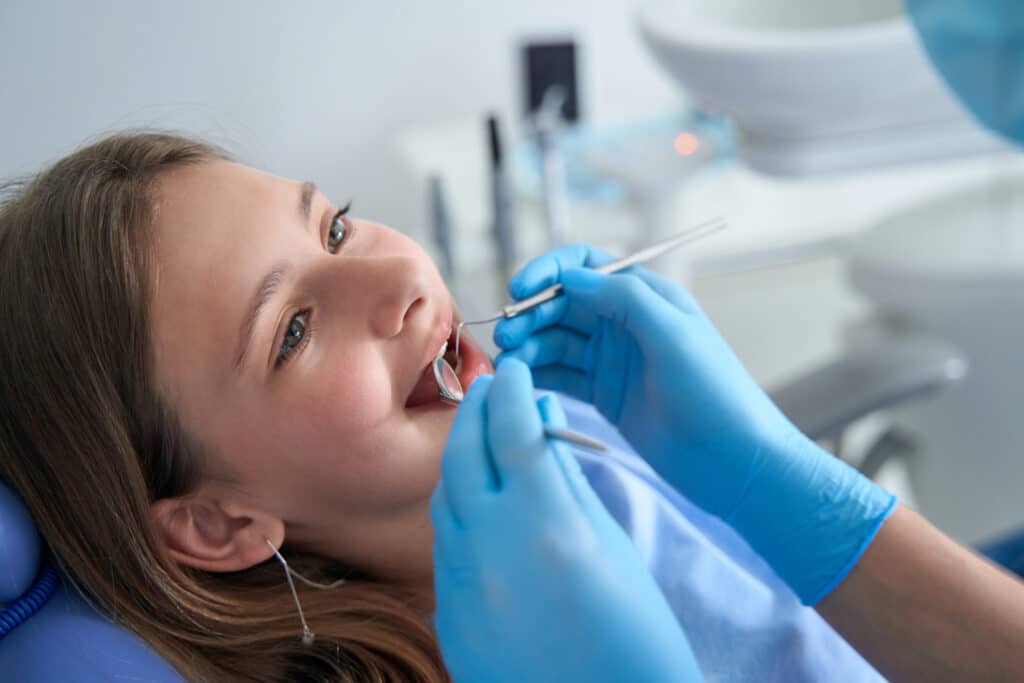
Pediatric dental anxiety management is a specialized behavioral approach that utilizes sensory adaptation, observational learning, and the Tell-Show-Do method to eliminate childhood dental fear. At a family practice, children watch their parents receive positive care, which normalizes the environment and replaces clinical intimidation with immediate confidence and comfort.
The 24-Hour Countdown: Preparing Your Child at Home
Medical literature supports that children with higher caries rates exhibited higher levels of anxiety and worse behavior during treatment, with tooth extraction being the most unacceptable treatment [1] (Bayon et al., 2025). How your family spends the day before a dental visit can impact your child’s anxiety level in the chair. Children thrive on predictability, so keep your home routine as normal as possible. Do not overhype the appointment or repeatedly ask them if they are scared, as this can accidentally manufacture anxiety where there was none previously. On the morning of your visit, avoid rushing. Pack your car early and give yourself plenty of time to navigate to the office so you do not arrive stressed. Finally, feed them a high-protein, low-sugar breakfast. Skipping sugary cereals prevents them from feeling jittery or hyperactive, making it easier for them to sit comfortably and calmly during their exam.
Table that compares pediatric dental care environments
Approach | Out-of-pocket cost | Anxiety management |
Corporate pediatric clinic | Moderate to high | Low |
Avoiding the dentist | No upfront cost; carries high risk of future expensive procedures | Very high |
Very low | Maximum |
Hitting Reset: Recovering from a Traumatic Dental Visit
Clinical literature suggests that a high level of dental trauma and the low percentage of children with trauma seeking treatment emphasize the need for greater awareness [2] (Saikiran et al., 2022). If your child had a terrifying experience at a high-volume clinic in the past, their fear is justified. At Chatham Family & Implant Dentistry, we specialize in minimizing the effects of past dental trauma. We start with desensitization. We invite you to book a free visit during which no clinical work is performed. Your child can simply walk around the office, meet our Pittsboro team, and realize this is a completely different, safer place. By taking baby steps and showing we respect their boundaries, we can overwrite their bad memories with positive, empowering new ones.
Sensory-Safe Care for Neurodivergent Children in Chatham County
Clinical evidence suggests that sensory-based interventions may be useful for improving functional outcomes and participation [3] (Piller et al., 2025). For children with ADHD, autism, or sensory processing disorders, a dental office can feel scary. Bright lights, leaning backward, and the vibration of a toothbrush can trigger severe distress. We believe every child deserves access to high-quality preventive care in an environment that honors their unique neurological needs. If your child has sensory sensitivities, please let our team know when you book your appointment. We will customize the physical space just for them. We can turn off harsh fluorescent lights and skip flavored polishing pastes that might cause texture aversions. We move at their speed, providing a quiet, predictable space where they feel completely secure.
The Strategic Advantage of Morning Appointments
When you are managing a busy family schedule, you might be tempted to squeeze your child’s dental cleaning in at 4:00 PM after school. By late afternoon, children are physically exhausted, overstimulated from their day, and much more likely to be irritable. To give your child the best chance of a tear-free visit, try to book their appointment first thing in the morning. Early in the day, toddlers and young kids are well-rested, fed, and highly cooperative. Getting the visit done early also means they do not have to spend their entire school day worrying about the upcoming appointment.
Reward Systems That Actually Build Dental Confidence
Positive reinforcement is a great way to celebrate a successful dental visit, but many parents accidentally use the wrong type of reward. Promising a trip to get ice cream or candy immediately after a dental cleaning is counterproductive to their oral health. Furthermore, bribing them before the appointment often signals that the event will be terrible. Instead, focus on rewarding their bravery with experiences. Promise a post-visit trip to a local Pittsboro park, a new coloring book, or a chance to choose the movie for family night. When praising them, be specific. Instead of just saying “good job,” say, “I am so proud of how well you kept your mouth open when the hygienist asked.” This specific praise builds long-term confidence and makes them proud of their new healthcare skills.
FAQS
1. What words should I avoid saying to my child before their dental visit?
Avoid using “trigger words” like shot, needle, drill, hurt, or pain. Even saying, “Don’t worry, it won’t hurt,” accidentally plants the idea that pain is a possibility. Instead, use positive language. Tell them we are going to “count their teeth,” “tickle their gums with a special brush,” and “take pictures of their smile.”
2. Can I stay in the room with my child if they are scared?
Yes. We operate a completely transparent, judgment-free practice. Parents are always welcome in our treatment rooms. For toddlers and highly anxious children, we often perform a “knee-to-knee lap exam,” where your child stays safely in your arms the entire time.
3. How do you handle a child with high sensory sensitivities?
We tailor the sensory environment to your child. We can dim the overhead lights, provide noise-canceling headphones, use lukewarm water to prevent temperature shock, and avoid loud ultrasonic tools, relying instead on quiet, gentle brushing techniques.
About The Author
Dr. Colin Barbaro, DDS, provides comprehensive general and cosmetic dentistry at Azalea Dental in Wilmington, NC. With advanced surgical training from a VA hospital residency, he specializes in implant placement, TMJ therapy, restorative care, and endodontics. He is committed to delivering safe, evidence-based solutions that keep patients comfortable and informed at every step.
References
[1] Bayón, G., Stiernhufvud, F., Ribas-Pérez, D., Biedma Perea, M., & Mendoza Mendoza, A. (2025). Parental Anxiety Disorders and Their Impact on Dental Treatment in Children Aged 4 to 13 Years: A Cross-Sectional Observational Study. Journal of clinical medicine, 14(6), 1869. https://doi.org/10.3390/jcm14061869
[2] Saikiran, K. V., Gurunathan, D., Nuvvula, S., Jadadoddi, R. K., Kumar, R. H., & Birapu, U. C. (2022). Prevalence of Dental Trauma and Their Relationship to Risk Factors among 8-15-Year-Old School Children. International journal of dentistry, 2022, 3343827. https://doi.org/10.1155/2022/3343827
[3] Piller, A., McHugh Conlin, J., Glennon, T. J., Andelin, L., Auld-Wright, K., Teng, K., & Tarver, T. (2025). Systematic review of sensory-based interventions for children and youth (2015-2024). Frontiers in pediatrics, 13, 1720179. https://doi.org/10.3389/fped.2025.1720179