
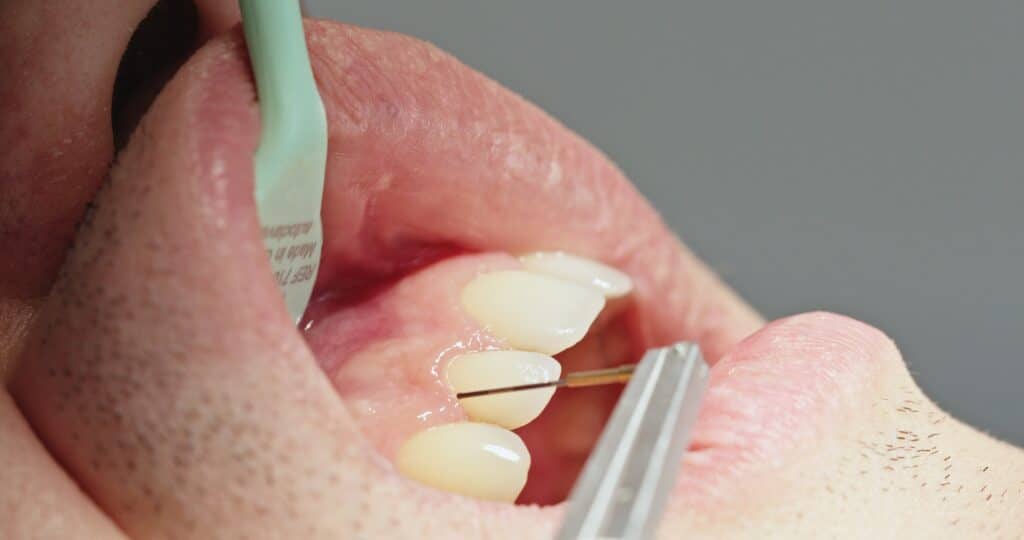
Scaling and root planing is a specialized, nonsurgical dental procedure that treats active periodontal disease. This two-step therapy safely removes hardened tartar from deep below the gumline and smooths the tooth roots, allowing your inflamed gum tissue to heal and securely reattach to your teeth.
How Treating Gum Disease Protects Your Total Body Health
Historically, the connection between the oral cavity and other areas of the body was not well understood. Today, we know that your oral health directly impacts your overall wellness. When you have untreated periodontal disease, the deep pockets in your gums act as a gateway. In fact, medical literature supports the view that understanding the interactions between periodontal disease and systemic conditions could guide integrated healthcare strategies [1] (Tattar et al., 2025). Harmful bacteria can enter your bloodstream and travel throughout your body, creating chronic inflammation. By treating a localized infection with scaling and root planing, you remove the bacterial burden and subsequently lower your risk for serious systemic conditions. For our health-conscious patients in Chatham County, a deep cleaning is a vital step in managing blood sugar levels for diabetics, supporting cardiovascular health, and even promoting a healthier pregnancy.
What Happens If You Ignore the Need for a Deep Cleaning?
It is incredibly tempting to ignore a gum disease diagnosis, especially if you are not currently in pain. However, periodontal disease is a “silent” infection. It will not heal on its own, and brushing harder at home will not reverse it. If left untreated, the tartar below your gumline will continue to breed aggressive bacteria. Clinical evidence supports the view that gingivitis is pathologically divided into initial, early, and established stages, with periodontitis considered the advanced stage. [2] (Daley et al., 2023). These bacteria release toxins that slowly eat away at the jawbone supporting your teeth. As this bone loss progresses, your gums will recede further, your teeth will become loose, and eventually, tooth loss becomes inevitable. Getting a deep cleaning at the first sign of 4mm or 5mm pockets stops this destructive cycle before irreversible bone damage occurs.
Table that compares treatment options
Feature | Standard cleaning | Scaling and root planing | Periodontal surgery |
Purpose | Preventive maintenance | Therapeutic treatment | Advanced intervention |
Depth of cleaning | Above the gumline | Deep below the gumline | Requires reflecting the gums back to access bone defects |
Anesthesia | Rarely | Local anesthesia | Local anesthesia |
Future maintenance | Every 65 months | 3 – 4 months | 3 months |
Advanced Technology for a More Comfortable Treatment
Clinical literature supports the use of a hand or ultrasonic scaler to remove subgingival calculus and bacterial deposits [3] (Oza et al., 2022). Many patients picture outdated, uncomfortable scraping when they hear the phrase deep cleaning. At Chatham Family & Implant Dentistry, we utilize modern dental technology to make your scaling and root planing experience surprisingly gentle and highly efficient. Instead of relying solely on traditional hand tools, our hygienists use state-of-the-art ultrasonic scalers. These advanced instruments emit high-frequency vibrations (up to 30,000 cycles per second) combined with a cooling water spray. This technology eradicates tartar from your tooth roots while flushing bacteria from deep pockets. This results in less time in the dental chair, minimal pressure, and a much faster healing time for your gums.
Post-Treatment Care: What to Eat and Avoid After Root Planing
One of the most common questions we hear is, “What can I eat after my deep cleaning?” Because your gums will be slightly tender and your teeth may experience temporary sensitivity to hot or cold, we recommend the following:
- For the first 48 hours after your procedure, stick to a soft-food diet. Options include yogurt, applesauce, scrambled eggs, smoothies, and mashed potatoes.
Items to avoid:
- Extreme temperatures: Avoid piping hot coffee or ice-cold drinks while your roots are sensitive.
- Hard, crunchy foods: Skip the chips, popcorn, and nuts. Small pieces can easily get lodged in your healing gum pockets, causing irritation.
- Spicy or acidic foods: Tomatoes, citrus, and heavy spices can sting your recovering gum tissue.
Life After a Deep Cleaning: The Importance of Periodontal Maintenance
Scaling and root planing does the heavy lifting to stop active disease, but keeping your gums healthy is an ongoing commitment. Once you have a history of periodontitis, you can no longer rely on a standard cleaning every six months. Instead, you will transition to a customized “Periodontal Maintenance” schedule. Because the specific bacteria that cause gum disease naturally repopulate in your mouth every 90 to 120 days. By visiting our Pittsboro office every 3 to 4 months, our hygienists can safely remove this bacteria before it has the chance to trigger inflammation and create new deep pockets. This proactive maintenance phase is the ultimate secret to keeping your natural teeth for a lifetime.
FAQS
1. How long does it take for gums to heal after a deep cleaning?
Most patients experience mild tenderness for 24 to 48 hours post-treatment. Your gums will undergo the most significant healing, shrinking, and reattachment over the following 4 to 6 weeks.
2. Can scaling and root planing save a loose tooth?
Yes, in many cases. If a tooth is slightly loose due to inflamed, infected gum tissue pulling away from it, cleaning out the infection allows the gums to tighten back up. This firm reattachment can often stabilize the tooth.
3. Will I need another deep cleaning in the future?
Ideally, no. Once the initial scaling and root planing is complete, we transition you to a “Periodontal Maintenance” schedule (usually a targeted cleaning every 3 to 4 months). As long as you maintain these visits and practice excellent home care, you should not need another intensive deep cleaning.
About The Author
Dr. Colin Barbaro, DDS, provides comprehensive general and cosmetic dentistry at Azalea Dental in Wilmington, NC. With advanced surgical training from a VA hospital residency, he specializes in implant placement, TMJ therapy, restorative care, and endodontics. He is committed to delivering safe, evidence-based solutions that keep patients comfortable and informed at every step.
References
[1] Tattar, R., da Costa, B. D. C., & Neves, V. C. M. (2025). The interrelationship between periodontal disease and systemic health. British dental journal, 239(2), 103–108. https://doi.org/10.1038/s41415-025-8642-2
[2] Daley JO, Jain P. Gingivitis. [Updated 2023 Mar 27]. In: StatPearls [Internet]. Treasure Island (FL): StatPearls Publishing; 2026 Jan-. Available from: https://www.ncbi.nlm.nih.gov/books/NBK557422/
[3] Oza, R. R., Sharma, V., Multani, P., Balsara, K., Bajaj, P., & Dhadse, P. (2022). Comparing the Effectiveness of Ultrasonic Instruments Over Manual Instruments for Scaling and Root Planing in Patients With Chronic Periodontitis: A Systematic Review and Meta-Analysis. Cureus, 14(11), e31463. https://doi.org/10.7759/cureus.31463