
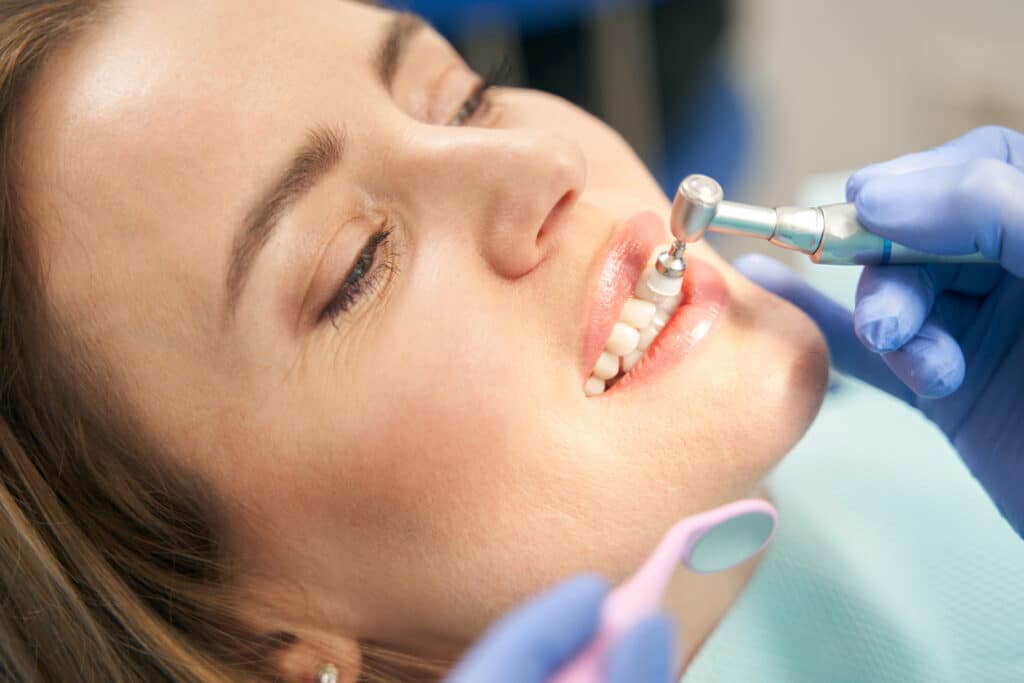
A professional dental cleaning at Chatham Family & Implant Dentistry does not damage or strip away healthy tooth enamel. When a licensed hygienist uses modern ultrasonic scalers and appropriately graded polishing pastes, routine cleanings safely remove calcified tartar and bacterial biofilm while preserving your enamel’s natural structural integrity.
Post-Cleaning Remineralization
A professional teeth cleaning does more than just strip away harmful bacteria; it physically primes your teeth to become stronger. When teeth are covered in a thick layer of plaque and tartar, the pores can become blocked. Calcium and phosphate cannot get in, but bacterial acid can still cause harm. Once our Pittsboro hygienists clear away that barrier, your bare enamel is highly receptive to remineralization. This is when we apply professional-grade fluoride varnishes or nano-hydroxyapatite treatments. Medical literature supports nano-hydroxyapatite as a promising alternative because it integrates with the enamel structure and supports ongoing mineral restoration [1] (Batha et al., 2025). Because the enamel pores are completely open and clean, these cavity-fighting minerals absorb rapidly and deeply into the tooth structure. Within hours of your appointment, your enamel is measurably harder, denser, and more resistant to daily acid attacks than it has been in months.
Table that compares at-home habits and professional cleanings
Enamel wear factor | Risk of enamel abrasion | Long-term durability of enamel | Maintenance |
Routine professional cleaning | Very low | Maximum | Bi-annual |
Hard-bristled toothbrushes | High | Low | Daily replacement needed |
CHarcoal toothpastes | Moderate to high | Low | Daily |
Sipping acidic drinks | Severe | Very low | Requires pH buffering |
Demystifying Post-Cleaning Sensitivity
If you have minor gum recession, the roots of your teeth can become exposed. Unlike the top of your tooth, your roots are not covered in thick enamel. When calcified tartar builds up over these exposed roots, it acts like a heavy, insulating blanket against cold air and liquids. When we safely remove that tartar to stop your gum disease, those microscopic root pores are suddenly exposed to temperature changes again. Your nerves are simply readjusting to normal stimulation. This sensitivity is temporary and usually fades within 48 to 72 hours as the minerals in your saliva naturally plug those microscopic pores.
The Acid Attack
Clinical evidence shows that foods and beverages high in acid wear away the enamel that protects your teeth [2] (ADA, 2022). Your teeth are covered in a microscopic protein film called the “pellicle.” This invisible layer acts as a natural shield against acidic foods. During a thorough professional polishing, this pellicle layer is temporarily buffed away to remove deep surface stains. It takes your saliva about two to three hours to naturally rebuild this protective film. If you leave our clinic and immediately drink a highly acidic sports drink, a diet soda, or a glass of wine, that acid can damage your unprotected enamel. This can temporarily soften the tooth structure. To keep your freshly cleaned enamel safe, we recommend sticking to a neutral diet for at least two hours after your visit.
Gentle Care for Seniors in Chatham County
Enamel is incredibly strong, but it is not immune to a lifetime of wear and tear. As we age, our enamel naturally thins out, which is why older teeth often appear slightly more yellow. Because aging enamel is thinner and more brittle, senior dental care requires a highly specialized, tissue-sparing approach. At Chatham Family & Implant Dentistry, we completely adapt our hygiene protocols for our older patients. We avoid aggressive manual scraping, which can irritate delicate, aging tooth roots. Instead, our hygienists use ultrasonic water scalers set to their lowest, gentlest frequencies. We also proactively screen for dry mouth, a common side effect of daily blood pressure or cholesterol medications. By combining ultra-gentle cleaning technology with targeted dry-mouth therapies, we help your natural enamel last a lifetime.
Seeing is Believing: Using Digital Co-Diagnosis to Track Enamel Health
Modern dentistry demands absolute transparency, so we use a process called “Digital Co-Diagnosis.” During your comprehensive exam, our doctors use wand-like intraoral cameras to capture well-lit, magnified images of your teeth. We project these images onto a large monitor directly in front of your chair. Our advanced 3D CBCT scanners and digital software also let us archive these images. When you return for your six-month checkups, we can overlay your new scans with your historical data. We can track the exact thickness of your enamel over the years, showing with mathematical precision that your routine cleanings preserve your tooth structure rather than wearing it away.
FAQS
1. Why do my teeth feel rough or porous right after a dental polish?
This is a common, temporary sensation. Before your cleaning, your teeth were coated in a slippery plaque biofilm. Once we polish away that film and the underlying tartar, you will feel the bare, clean surface of your enamel. Within a few hours, the protective proteins in your natural saliva will recoat the teeth, restoring that glass-smooth feeling.
2. Can I ask my hygienist to skip the polishing step to save my enamel?
Yes, you are always in control of your appointment. If you have severe enamel erosion or incredibly sensitive teeth, just let our team know. We can easily skip the traditional gritty polish and rely on our ultra-quiet ultrasonic water tools to safely clean your smile.
3. Does removing tartar leave permanent scratches on my teeth?
No. Stainless steel dental scalers and ultrasonic tips are specifically designed to be softer than human enamel. While they are strong enough to crack and dislodge calcified tartar, they physically cannot scratch or shave down healthy, intact tooth enamel when used by a licensed professional.
About The Author
Dr. Colin Barbaro, DDS, provides comprehensive general and cosmetic dentistry at Azalea Dental in Wilmington, NC. With advanced surgical training from a VA hospital residency, he specializes in implant placement, TMJ therapy, restorative care, and endodontics. He is committed to delivering safe, evidence-based solutions that keep patients comfortable and informed at every step.
References
[1] Batha, A. A., Samanta, U., Datta, S., Chadha, A., Jaidka, S., & Jawa, D. (2025). Remineralization potential of fluoridated and non-fluoridated toothpastes on induced dental caries: A comparative in vitro analysis. Bioinformation, 21(7), 2035–2039. https://doi.org/10.6026/973206300212035
[2] ADA. (2022). Dietary Acids and Your Teeth. Mouthhealthy.org. https://www.mouthhealthy.org/all-topics-a-z/dietary-acids-and-your-teeth