
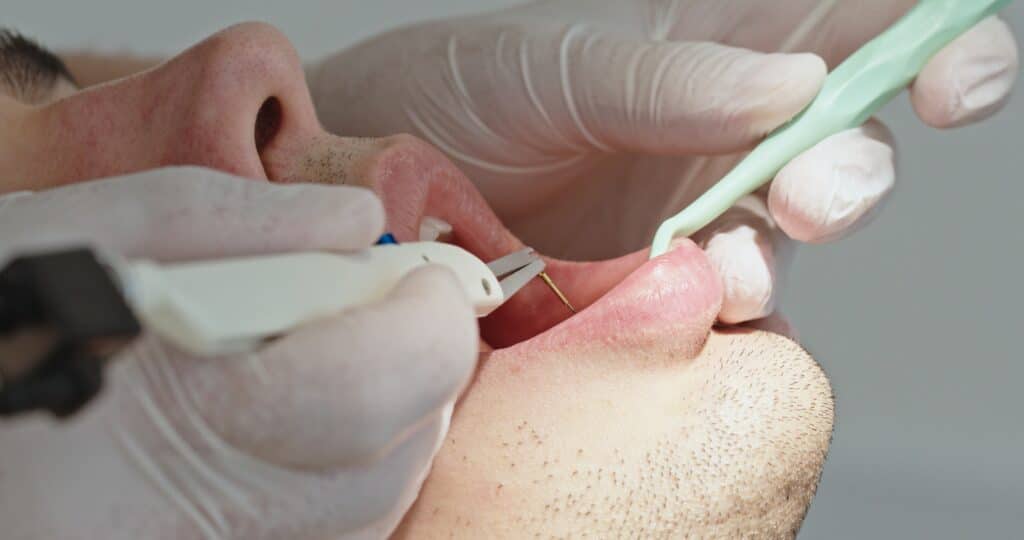
A general dentist-led deep cleaning is an advanced periodontal therapy performed directly at your primary dental clinic. At Chatham Family and Implant Dentistry, we perform targeted scaling and root planing to reverse gum disease, ultimately saving you time, premium costs, and the logistical hassle of being referred to an outside periodontist for mild-to-moderate cases.
How Long Does an In-House Deep Cleaning Take?
One of the biggest advantages of skipping the specialist referral is that it streamlines your time in the chair. Typically, an in-house deep cleaning is completed over two separate visits, usually spaced about a week or two apart. During each appointment, your hygienist will focus on one side of your mouth (either the right or the left). This ensures you are never completely numb and can eat comfortably later that day.
- The First Visit: Takes roughly 60-90 minutes. We numb the first half of your mouth, perform scaling and root planing, and review your home care instructions.
- The Second Visit: Takes another 60-90 minutes to treat the other side.
Because you are not driving to a separate consultation appointment at a specialist’s office just to get a treatment plan, you reclaim hours of your week.
4 Signs You Can Safely Skip the Periodontist Referral
How do you know if your gums can be treated by your general dentist? While we always perform a thorough clinical exam to determine your exact needs, here are four strong indicators that an in-house deep cleaning is the perfect fit for you:
- Pocket Depths Between 4mm and 5mm: Healthy gums have a shallow 1-3mm pocket. If your pockets are just starting to deepen (4-5mm), we can easily reach and clear the bacteria without surgical intervention. These efforts are designed to prevent worsening infections. For example, dental literature has sufficient evidence supporting that as gingivitis advances to periodontitis, anaerobic bacteria such as A actinomycetemcomitans and P gingivalis colonize deeper periodontal pockets, triggering a host inflammatory response [1] (Gasner et al., 2025). In-house deep cleanings can significantly assist in preventing a local inflammatory response.
- No Severe Tooth Mobility: If your teeth feel stable and are not noticeably loose, your bone support is likely strong enough for non-surgical scaling.
- No Need for Gum Grafting: If you are not experiencing severe, aesthetic gum recession that requires tissue grafts, a general dental setting is ideal. If you do need surgery, medical evidence suggests that Soft tissue grafting is among the most common periodontal surgical procedures performed in the U.S. [2] (Chan et al., 2015).
- Routine Health History: If you do not have complex, uncontrolled systemic health conditions that complicate healing, your primary dental team can safely manage your care.
Table of Provider Comparisons
Feature | Standard dental cleaning | Scaling and root planing | Periodontist deep cleaning |
Best for | Healthy gums | Mild to moderate gum disease | Severe |
Referral needed? | No | No | Usually yes |
Relative cost | Lowest | Moderate | Highest |
Wait time | Routine scheduling | Fast | Longer |
Maintenance | Every 6 months | Every 3 to 4 months | Every 3 to 4 months |
Clinic Technology: Achieving Specialist-Level Results in Pittsboro
A common fear is that staying with a general dentist means missing out on top-tier treatment. The truth is, modern dental technology has leveled the playing field for non-surgical gum care. At Chatham Family & Implant Dentistry, our hygienists utilize advanced ultrasonic scalers. Instead of relying solely on traditional metal hand-scrapers, these ultrasonic tools use high-frequency vibrations and a targeted stream of water to gently blast away hardened tartar and flush out bacteria. This technology not only results in a far more comfortable experience for you but also allows us to achieve the same pristine, bacteria-free root surfaces that a periodontist would, right here in our Pittsboro clinic.
Recovery Realities: What to Expect the First 48 Hours
A major relief for many patients is discovering that recovering from a non-surgical deep cleaning is incredibly straightforward. Because no incisions or stitches are involved, the downtime is minimal. Once the localized numbing wears off, you might feel mild tenderness or a slight throbbing in your gums. Your teeth may also be temporarily sensitive to hot or cold drinks. However, this is easily managed. A standard dose of over-the-counter Ibuprofen (Advil) and gentle warm saltwater rinses are usually all you need. Most of our patients return to work, run errands around town, and resume their normal daily activities the exact same day.
The "Periodontal Maintenance" Phase: Your Long-Term Success Plan
Gum disease is a lot like high blood pressure; it can be successfully managed, but it cannot be permanently “cured” with a single treatment. Once your deep cleaning is complete, you graduate to a specialized follow-up program called Periodontal Maintenance. Instead of a standard teeth cleaning every six months, you will visit us every 3 to 4 months. Aggressive bacteria that cause gum disease take roughly 90 days to repopulate in your gum pockets. By keeping your care in-house, your maintenance visits are handled by the exact same hygienist who performed your deep cleaning.
FAQS
1. When does a general dentist actually refer you to a periodontist?
While we handle the vast majority of deep cleanings in-house, we will refer you to a trusted local periodontist if you have severe, advanced periodontitis requiring complex gum grafting, bone grafting, or specialized laser surgery beyond non-surgical scaling.
2. Will my insurance cover a deep cleaning if it’s not done by a specialist?
Yes. Dental insurance providers recognize and fully cover scaling and root planing when performed by a licensed general dentist. In fact, many insurance networks prefer you stay with your primary dentist, as it is more cost-effective.
3. Can I drive myself home after getting a deep cleaning at your Pittsboro clinic?
Absolutely. Because a deep cleaning is a non-surgical procedure, we typically only use a local anesthetic to numb your gums. You will be fully awake, alert, and safe to drive yourself home or back to work immediately after your appointment.
References
[1] Gasner NS, Schure RS. Periodontal Disease. [Updated 2025 May 12]. In: StatPearls [Internet]. Treasure Island (FL): StatPearls Publishing; 2026 Jan-. Available from: https://www.ncbi.nlm.nih.gov/books/NBK554590/
[2] Chan, H. L., Chun, Y. H., MacEachern, M., & Oates, T. W. (2015). Does Gingival Recession Require Surgical Treatment?. Dental clinics of North America, 59(4), 981–996. https://doi.org/10.1016/j.cden.2015.06.010