
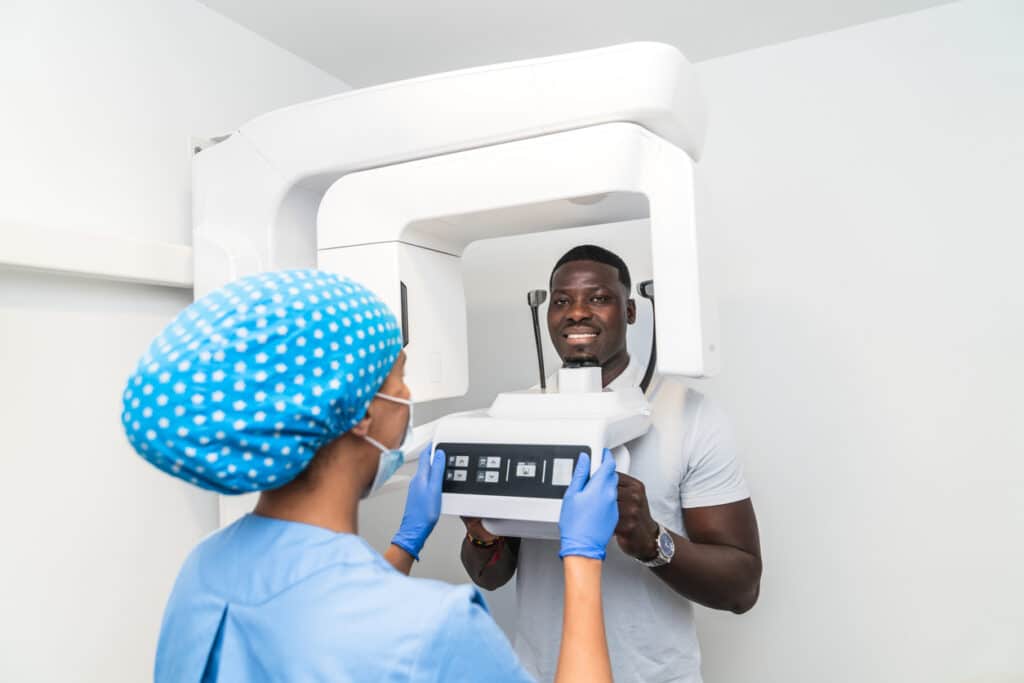
A next-generation 3D dental exam at Chatham Family & Implant Dentistry is an advanced diagnostic evaluation that uses Cone Beam Computed Tomography (CBCT) to capture highly detailed, three-dimensional images of your teeth, jawbone, and nerve pathways. This technology eliminates diagnostic guesswork, detecting hidden issues long before they cause pain. The medical literature indicates that emerging technologies, including three-dimensional (3D) imaging, digital scanning, and telemedicine, have significantly enhanced the diagnostic accuracy and patient monitoring capabilities of dental practices [1] (Cioboata et al., 2025).
Uncovering the Root Cause of Sleep Apnea and Snoring
If you wake up feeling exhausted or your partner constantly complains about your loud snoring, the problem might actually be located inside your mouth. Traditional flat X-rays only show your dental architecture, but cannot reveal the soft tissues of your throat and nasal passages. During your next-gen exam at our Pittsboro clinic, our 3D CBCT scanner performs a complete airway analysis. We can virtually measure the volume of your airway in three dimensions to pinpoint exact bottlenecks. By visualizing collapsed tissues or a narrowed airway, we can often treat your sleep-disordered breathing with a simple, custom-fit oral appliance. You get to breathe easier and finally enjoy a restful night of sleep.
Table that compares diagnostic options
Diagnostic tool | Diagnostic depth | Radiation profile | Scan time | Best for |
2D bitewing X-rays | Low | Very low | 5-10 minutes | Routine cavity checks between molars |
Panoramic 2D X-ray | Moderate | Very low | 15-20 seconds | Tracking wisdom teeth eruption |
Next-gen 3D CBCT | Maximum | Ultra-low dose | 20-30 seconds | Implants |
Making Root Canals Painless and Predictable
Clinical literature supports that dental anxiety (DA) and oral health-related quality of life (OHRQoL) are correlated and associated in patients with periodontitis [2] (Padilla-fonseca et al., 2024). Hearing that you have an infected tooth can instantly trigger dental anxiety. Much of that fear comes from old stories of failed procedures or unexpected pain. Historically, those failures happened because dentists had to use flat 2D X-rays, making it incredibly easy to miss a hidden, microscopic nerve canal. 3D imaging completely rewrites this narrative. Clinical evidence suggests that patients with dental anxiety still have worse oral hygiene than patients without dental anxiety [3] (Zinke et al., 2018). Our doctors can digitally alter your tooth on the monitor, revealing the exact number, shape, and curve of every single root canal before your treatment even begins. This extreme precision means your visit is much faster, completely numb, and highly successful on the very first try.
The End of Claustrophobic Dental X-Rays
For many patients, the absolute worst part of a dental checkup is having sharp, bulky plastic sensors pushed to the very back of their mouth. If you have a severe gag reflex, a small mouth, or sensitive gums, getting a clear image used to be a painful struggle. A 3D CBCT scan is a completely hands-free, open-air experience. You simply stand or sit comfortably while the scanner glides silently around your head. The entire scan takes less than 30 seconds, making it the ultimate comfort upgrade for anxious adults and restless kids.
Precision Planning for Clear Aligners
Straightening your smile as a busy professional is a fantastic investment in your confidence. However, shifting your teeth safely requires knowing exactly what is happening beneath the gumline. Trying to move teeth without checking the surrounding jawbone can lead to severe root damage or loose teeth down the road. Before we design your clear aligner trays, your 3D exam provides a complete map of your roots and bone density. We ensure you have a rock-solid, healthy foundation to support the movement. This specialist-level planning guarantees your cosmetic results look stunning and stay structurally sound for decades.
Building Your Lifetime Digital Health Archive
Your oral health is not just a quick snapshot; it is a moving timeline. When you choose an independent family dentist in Chatham County, your 3D scans do more than just diagnose today’s issues. They become part of your permanent, highly secure digital health archive. If you experience a sudden change in your bite or unexplained jaw pain three years from now, our doctors can pull up your exact 3D baseline from today. We can digitally overlay the scans to track microscopic changes in your jaw joint (TMJ) or bone levels over time. This long-term tracking allows us to intervene early and keep your smile perfectly on track year after year.
FAQS
1. Does a 3D dental scan expose me to high radiation?
No. Modern CBCT scanners are specifically designed for dental use. They emit a highly focused, ultra-low dose of radiation—significantly less than a traditional medical CT scan at a hospital. The diagnostic benefits of catching a hidden infection far outweigh the minimal exposure.
2. Do I need a 3D CBCT scan at every routine checkup?
Not at all. While we perform standard preventive cleanings every six months, a full 3D CBCT scan is typically only required every 3 to 5 years to update your diagnostic baseline. We also utilize it specifically if you are experiencing sudden, undiagnosed pain or planning for a surgical procedure like an implant
3. Can 3D imaging help diagnose my TMJ jaw pain?
Absolutely. Flat X-rays cannot accurately capture the complex ball-and-socket joint of your jaw.
About The Author
Dr. Colin Barbaro, DDS, provides comprehensive general and cosmetic dentistry at Azalea Dental in Wilmington, NC. With advanced surgical training from a VA hospital residency, he specializes in implant placement, TMJ therapy, restorative care, and endodontics. He is committed to delivering safe, evidence-based solutions that keep patients comfortable and informed at every step.
References
[1] Cioboata, R., Balteanu, M. A., Mitroi, D. M., Catana, O. M., Tieranu, M. L., Vlasceanu, S. G., Tieranu, E. N., Biciusca, V., & Mirea, A. A. (2025). Interdisciplinary Perspectives on Dentistry and Sleep Medicine: A Narrative Review of Sleep Apnea and Oral Health. Journal of clinical medicine, 14(15), 5603. https://doi.org/10.3390/jcm14155603
[2] Padilla-Fonseca, N., Araya-Castillo, A., Arias-Campos, M. P., Solís-Rivera, A. P., Jiménez-Matarrita, J., & Ramírez, K. (2024). The Relationship Between Dental Anxiety and Oral Health-Related Quality of Life in Patients with Periodontitis. Diagnostics (Basel, Switzerland), 14(23), 2624. https://doi.org/10.3390/diagnostics14232624
[3] Zinke, A., Hannig, C., & Berth, H. (2018). Comparing oral health in patients with different levels of dental anxiety. Head & face medicine, 14(1), 25. https://doi.org/10.1186/s13005-018-0182-4