
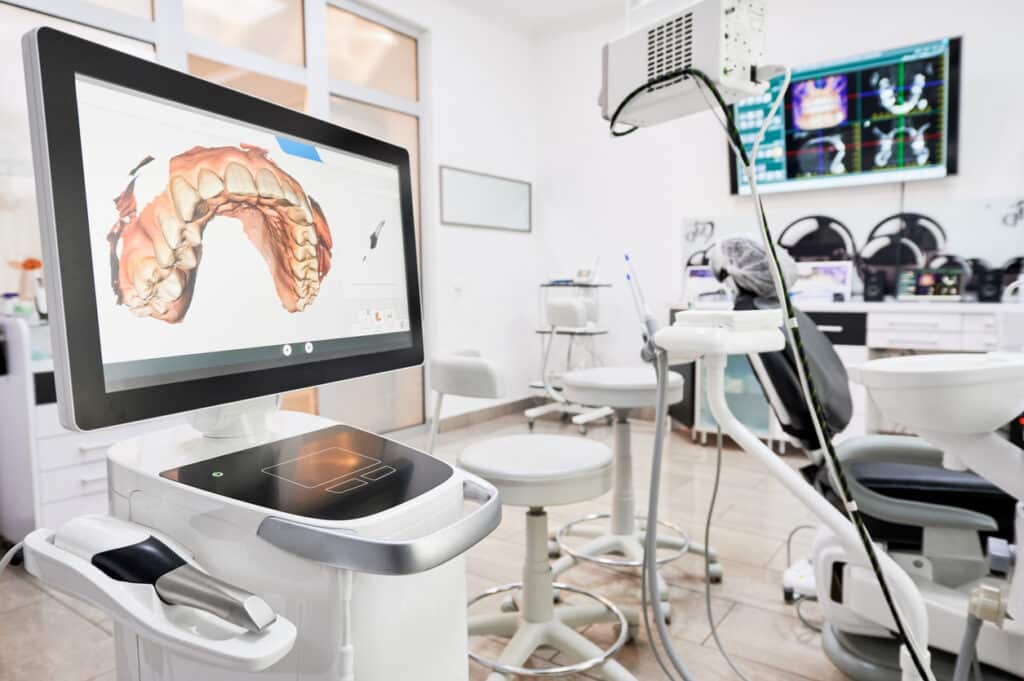
Advanced dental technology refers to the integration of modern digital diagnostic and treatment tools such as 3D CBCT imaging, digital impressions, and ultrasonic scalers to improve clinical accuracy, reduce chair time, and eliminate patient discomfort during routine preventive and restorative dental procedures.
AI-Assisted Diagnostics
The medical literature indicates that AI is rapidly advancing in dentistry and has demonstrated significant benefits [1] (Gao et al., 2025). Microscopic signs of decay can occasionally hide in the shadows of a traditional X-ray. That is why we augment our digital X-rays with advanced diagnostic software. This smart technology analyzes your high-resolution images, cross-referencing them against millions of dental scans to highlight the earliest, microscopic signs of enamel demineralization. It acts as a highly precise second opinion built right into our software. By spotting these tiny problem areas before they erode your enamel, we can intervene with simple, remineralizing fluoride therapies rather than waiting until the tooth has decayed.
Preview Your Results Before Treatment Begins
One of the biggest fears for most patients is spending their hard-earned money only to dislike the final result. At Chatham Family & Implant Dentistry, we eliminate that aesthetic anxiety with Digital Smile Design software. Instead, we use digital intraoral scanners to build a 3D model of your current face and teeth. We then digitally manipulate that model on a screen right in front of you to show you exactly what your new smile will look like. You get to “try on” your new teeth virtually, allowing you to suggest tweaks to the shape, length, and shade. This collaborative technology guarantees that you can accurately anticipate the appearance of your final results.
A table that compares high-tech and traditional dentistry
Feature | Traditional clinic | Modern digital clinic |
Diagnostic accuracy | Moderate | High |
Chair time | 60-90 minutes | 30-45 minutes |
Restoration | Good | Micron-level accuracy |
Cost | Lower upfront | Cost-effective |
Virtual Surgical Planning (VSP)
Medical evidence suggests notable advantages of VSP in oral surgery, including improved surgical precision, reduced operative time, and enhanced patient outcomes [2] (Bhatt et al., 2025). The phrase “dental implant surgery” often brings up fears of long, painful recoveries. Today, modern 3D CBCT technology has transformed implant placement into a highly predictable, minimally invasive procedure. Long before your actual appointment, our Pittsboro doctors use your 3D jaw scans to perform a virtual surgery on a computer. We digitally map out the exact density of your jawbone and the precise location of your facial nerves. We then create a custom 3D-printed surgical guide based on this digital map. When you come in for the actual procedure, this guide allows us to place the implant at the perfect angle and depth in a matter of minutes. This eliminates unnecessary tissue cutting, which means significantly less swelling, zero nerve damage, and a remarkably fast recovery time for you.
Solving Chronic Fatigue from the Dental Chair
Many patients in the Triangle area struggle with loud snoring, chronic fatigue, and brain fog without realizing the root cause is actually located in their mouth. During your comprehensive exam, we do not just look at your teeth; we use our 3D imaging technology to perform a complete Airway Analysis. Our scanners can instantly measure the volume and width of your throat, identifying physical bottlenecks that restrict your oxygen while you sleep. Clinical literature supports that Obstructive sleep apnea (OSA) remains a significant and underdiagnosed public health issue with wide-reaching systemic consequences [3] (Szmyt et al., 2026). By visualizing your airway in 3D, we can better visualize why you are struggling to breathe at night. Often, we can resolve these sleep-disordered breathing issues with a simple, custom-fitted oral appliance, helping you avoid loud CPAP machines and finally get a restful night’s sleep.
Co-Diagnosis via High-Definition Intraoral Cameras
We operate under a completely different philosophy called “Co-Diagnosis.” We use high-definition, wand-like intraoral cameras to take brightly lit, magnified video of the inside of your mouth. We project that video onto a large monitor positioned directly in front of your chair. If you have a cracked molar, a leaking silver filling, or inflamed gums, you will see it in full color. By turning our advanced technology into an educational tool, we eliminate the clinical mystery. You are no longer just a passive patient; you become an active, informed partner in your own healthcare decisions.
FAQS
1. Are digital dental X-rays safer for my family than traditional film?
Absolutely. Modern digital X-ray sensors require up to 90% less radiation to produce an image compared to traditional analog film X-rays. They are incredibly safe for patients of all ages, including young children and seniors, providing unparalleled diagnostic clarity with minimal exposure.
2. Do digital impressions completely replace traditional dental molds?
For the vast majority of restorative and cosmetic treatments, yes! We use wand-like digital scanners to quickly map your mouth in 3D. This completely eliminates the need for the bulky, gag-inducing putty trays traditionally used for crowns, clear aligners, and nightguards.
3. How does modern dental technology lower my out-of-pocket costs?
Precision prevents expensive problems. High-tech tools like intraoral cameras and 3D imaging allow us to detect the earliest signs of decay and gum disease. Treating a tiny issue today with a simple, low-cost filling prevents you from needing a highly expensive, complex surgical procedure next year.
About The Author
Dr. Colin Barbaro, DDS, provides comprehensive general and cosmetic dentistry at Azalea Dental in Wilmington, NC. With advanced surgical training from a VA hospital residency, he specializes in implant placement, TMJ therapy, restorative care, and endodontics. He is committed to delivering safe, evidence-based solutions that keep patients comfortable and informed at every step.
References
[1] Gao, S., Wang, X., Xia, Z., Zhang, H., Yu, J., & Yang, F. (2025). Artificial Intelligence in Dentistry: A Narrative Review of Diagnostic and Therapeutic Applications. Medical science monitor : international medical journal of experimental and clinical research, 31, e946676. https://doi.org/10.12659/MSM.946676
[2] Bhatt, M. A., Kemmu, A., Choudhary, A., Baghel, A., Parthasarathy, B., & P, A. (2025). Use of Virtual Surgical Planning in Oral Surgery: A Systematic Review. Cureus, 17(3), e81051. https://doi.org/10.7759/cureus.81051
[3] Szmyt, J., Szczapa, T., Chyła, M., Bęben, A., & Maciejewska, I. (2026). Obstructive Sleep Apnea: The Expanding Role of Dental Sleep Medicine-A Systematic Review of Mandibular Advancement Devices, Treatment Efficacy, and Occlusal Complications. Dentistry journal, 14(1), 62. https://doi.org/10.3390/dj14010062